Chrissie’s Story: “I’ve gone from existing to living – and now I’m helping others do the same”
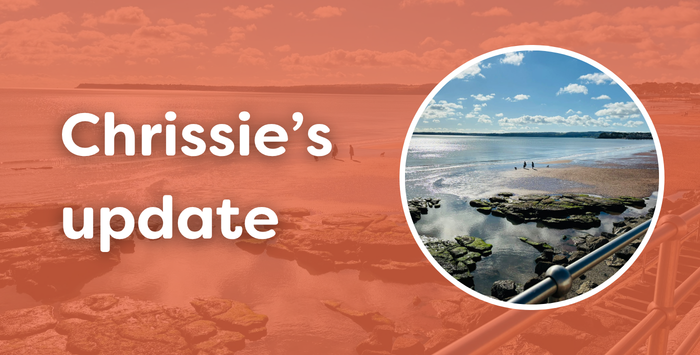
When we first shared Chrissie’s story, she spoke honestly about living with anxiety, OCD and agoraphobia, and the isolation she had quietly endured for over 40 years.
Her words – “I’ve gone from existing for 40 years to living now” – resonated deeply with many people. Since then, her journey has continued in ways that have surprised even her, through learning, volunteering, going outside, and discovering that she has something remarkable to offer others.
Over the past year, Chrissie has thrown herself into studying. She completed Counselling Level 2, alongside a series of mental health courses covering topics including stress, anxiety, and OCD – subjects she thought would feel familiar.
“Because I suffer from OCD and agoraphobia, I thought those two would be really easy, but they proved to be the hardest to actually write about.”
The courses turned out to be more than just academic. They were eye-opening in ways she hadn’t anticipated, revealing how much overlap there is between different conditions, and helping her understand herself and others more deeply. And once she started, the team at Step One made sure she didn’t stop.
“As soon as I finished one, Sharon would email me another or Tom would send me a link to another one. They didn’t let me sit still for a minute! But I loved it.”
Sharon, who had been encouraging Chrissie for some time, could see something in her that Chrissie was only beginning to see herself: that she had both the empathy and the attitude to volunteer. The push came gently, and then a Facebook advert for Step One volunteers appeared at just the right moment.
“It was as if it was meant to be. And it was the best decision I ever made, to be honest.”
Chrissie now volunteers regularly with Step One, and the scope of what she does has grown steadily. On Mondays she leads the creative writing group, writing the prompts herself, and on Tuesdays she runs a session that combines a check-in with a social quiz. She also co-facilitates HOPE courses and steps in as an additional presence on workshops and courses whenever someone might need extra support.
The creative writing sessions, in particular, have grown into something special. Up to fifteen people join regularly, and Chrissie has seen first-hand how much it means to them, even on the days when motivation is hard to find.
“A few people who come on at 3pm say “I don’t want to come today as I wasn’t feeling great”, but they came on anyway. And at the end, they’ve written a terrific story or a poem. Sometimes people draw. And it’s just amazing.”
What has surprised her most, though, is how natural it all feels.
“I think it was about the third time I was doing a session on my own and I thought – where are my nerves? I didn’t feel right, because I wasn’t nervous.”
That moment was a quiet revelation. For someone who spent months with her camera off and barely spoke in her first sessions, it said everything about how far she had come.
Running sessions is one thing. Understanding how to do it well is another. To help with that, Chrissie completed an eight-week Peer Support Leaders course, something she recommends enthusiastically to anyone in a similar role.
“If you want to train someone, I would always say to Tom – send them on that course. I learned a lot of little things through those eight weeks.”
One of the most valuable aspects was learning how to hold boundaries, particularly as she had become genuine friends with many of the people in her groups. The course helped her understand how to balance warmth with professionalism and how to phrase things in ways that guided rather than told. She also found herself in a group of people from across the country – from someone just starting a peer group in a coffee shop to someone establishing a large workplace support network – and the connections made the learning richer.
“We all gelled really well. And the facilitators were really kind and helpful.”
Recovery, Chrissie is clear, is not a straight line. Around Christmas, several things hit at once. She was still processing grief for her father; she had been so focused on supporting her sister during the first year that her own mourning had been delayed. And then the week before Christmas, she was diagnosed with Type 2 diabetes.
“I curled into a ball for 24 hours. But that was fine. I knew how to get out of it. I just needed that day to say – okay, this is what I’ve got to do now.”
What was different this time was that she reached out – something that had always been hard for her, and is slowly, carefully, becoming easier.
“I’m learning to find full stops, and to stop things from going backwards, or even sideways, I like to think of it. Deal with what I have to deal with in that moment. And then slowly start to move forward. Or sometimes you find yourself bursting forward, which is lovely.”
Alongside reaching out, she has found another tool that has quietly become one of her most important: journaling. During a painful bout of toothache – she spent about a week, as she puts it, “looking like a hamster” – she couldn’t go online or join sessions, and instead sat and wrote everything that had been going on in her head.
“I wrote it like a worry diary. Hypothetical things I took off the list. Things I could do something about now, I did. I actually made phone calls and sorted out things I had been holding back on for a long time.”
She found that putting feelings on paper allowed her to read them back as though someone else had written them – a way of processing that felt less exposing than speaking, but just as real.
Perhaps the most remarkable development of the past year is one that might seem small from the outside, but is anything but for Chrissie. With support from Jessica at Devon Mental Health Alliance, she has been taking steps, literally, outside her front door.
“We actually made it to the end of the long driveway. That’s about 60 steps.”
She was within five steps of the pavement when things stalled around Christmas. But she doesn’t see it as a failure.
“It’s been decades, so I wasn’t expecting to break any records.”
What stays with her is how it felt, not how far she got.
“It felt freeing, but it was also very frightening. Knowing that the freeing feeling was there was more intense than the panicking.”
More recently, as part of co-facilitating the Reframe photography course with Step One, she stepped outside to photograph a tree.
“I went 10 steps out. And the people in the group – some of them are from the peer groups I help run – the grins on their faces when I said I’d done it. They’re all supportive, they all know.”
That shared celebration, she says, made it feel worth it.
One of the quieter shifts Chrissie describes is something many people will recognise, even if they’ve never found the words for it.
“My confidence is still going up, and I can’t believe it’s still going up. I’m waiting for it to drop, but it hasn’t. And I’m more content with myself, because I never liked myself before.”
She is careful to distinguish contentment from happiness.
“Finding that you can be content with how you are doesn’t mean you’re always happy, because you’re not. Everybody has ups and downs. But you can still be content with yourself even if you’re annoyed with yourself.”
There is, she says, something in her that has always been there – a natural tendency to look for the silver lining in things. Her father used to tease her about it, calling her his Pollyanna. What Step One gave her, she feels, wasn’t a new personality. It was the conditions for what was already there to grow.
For anyone reading this who is where Chrissie was two years ago – camera off, barely speaking, uncertain whether any of it could help – she has this to say:
“Get your courage up and just take a few steps forward that you don’t think you might be able to do, because it’s surprising what you can do when you don’t think you can. Little seeds will be planted, without you knowing, of skills and tools that you can use to improve your life.”
She is honest that not every tool works for every person, or at every stage, but encourages patience.
“Be patient with yourself. Some things will click straight away. Other things may not work for you now but might further along your journey. Just find that little glimmer of hope somewhere, especially when you’re in those really dark days at the beginning.”
Chrissie is already working on a decluttering workshop she hopes to run herself one day. She would love to attend face-to-face crafting groups. And she has one dream that she holds onto – to reach the beach.
“When I do, everybody’s invited to the beach party.”
Her journey is a reminder that recovery is not always about huge leaps forward. Often, it is steady steps, supportive people, and discovering strengths you never knew you had. And sometimes, it is taking ten steps outside to photograph a tree – and seeing the people who know what that means light up when you tell them.
 https://steponecharity.co.uk/wp-content/uploads/2026/06/Website-News-Headers-2024-24.png
355
700
Isaac Mann
https://steponecharity.co.uk/wp-content/uploads/2024/02/step-one-wellbeing.svg
Isaac Mann2026-07-02 13:26:042026-07-02 15:26:24Celebrating 25 Years of Dedication: Lesley Clift’s Journey with Step One
https://steponecharity.co.uk/wp-content/uploads/2026/06/Website-News-Headers-2024-24.png
355
700
Isaac Mann
https://steponecharity.co.uk/wp-content/uploads/2024/02/step-one-wellbeing.svg
Isaac Mann2026-07-02 13:26:042026-07-02 15:26:24Celebrating 25 Years of Dedication: Lesley Clift’s Journey with Step One https://steponecharity.co.uk/wp-content/uploads/2026/07/Website-News-Headers-2024-26.png
355
700
Isaac Mann
https://steponecharity.co.uk/wp-content/uploads/2024/02/step-one-wellbeing.svg
Isaac Mann2026-07-02 13:25:322026-07-03 09:50:08My week with Step One Charity by Zoe Godfrey
https://steponecharity.co.uk/wp-content/uploads/2026/07/Website-News-Headers-2024-26.png
355
700
Isaac Mann
https://steponecharity.co.uk/wp-content/uploads/2024/02/step-one-wellbeing.svg
Isaac Mann2026-07-02 13:25:322026-07-03 09:50:08My week with Step One Charity by Zoe Godfrey https://steponecharity.co.uk/wp-content/uploads/2026/06/Website-News-Headers-2024-22.png
355
700
Isaac Mann
https://steponecharity.co.uk/wp-content/uploads/2024/02/step-one-wellbeing.svg
Isaac Mann2026-06-12 09:52:052026-06-12 14:56:05Nine Years of Service: Robert Williams Reflects on His Time as Trustee
https://steponecharity.co.uk/wp-content/uploads/2026/06/Website-News-Headers-2024-22.png
355
700
Isaac Mann
https://steponecharity.co.uk/wp-content/uploads/2024/02/step-one-wellbeing.svg
Isaac Mann2026-06-12 09:52:052026-06-12 14:56:05Nine Years of Service: Robert Williams Reflects on His Time as Trustee https://steponecharity.co.uk/wp-content/uploads/2026/05/Website-News-Headers-2024-20.png
355
700
Isaac Mann
https://steponecharity.co.uk/wp-content/uploads/2024/02/step-one-wellbeing.svg
Isaac Mann2026-05-08 10:25:462026-05-08 11:23:26Mental Health Awareness Week: Taking Action Together
https://steponecharity.co.uk/wp-content/uploads/2026/05/Website-News-Headers-2024-20.png
355
700
Isaac Mann
https://steponecharity.co.uk/wp-content/uploads/2024/02/step-one-wellbeing.svg
Isaac Mann2026-05-08 10:25:462026-05-08 11:23:26Mental Health Awareness Week: Taking Action Together https://steponecharity.co.uk/wp-content/uploads/2026/02/Becky-T-15-years.png
355
700
Isaac Mann
https://steponecharity.co.uk/wp-content/uploads/2024/02/step-one-wellbeing.svg
Isaac Mann2026-04-17 13:42:282026-04-17 13:42:2815 Years of Impact: Becky Tucker’s Journey at Step One
https://steponecharity.co.uk/wp-content/uploads/2026/02/Becky-T-15-years.png
355
700
Isaac Mann
https://steponecharity.co.uk/wp-content/uploads/2024/02/step-one-wellbeing.svg
Isaac Mann2026-04-17 13:42:282026-04-17 13:42:2815 Years of Impact: Becky Tucker’s Journey at Step One https://steponecharity.co.uk/wp-content/uploads/2026/02/5-minutes-with-Lorna.png
355
700
Isaac Mann
https://steponecharity.co.uk/wp-content/uploads/2024/02/step-one-wellbeing.svg
Isaac Mann2026-03-24 09:40:262026-03-24 10:21:275 minutes with Lorna Collingwood-Burke
https://steponecharity.co.uk/wp-content/uploads/2026/02/5-minutes-with-Lorna.png
355
700
Isaac Mann
https://steponecharity.co.uk/wp-content/uploads/2024/02/step-one-wellbeing.svg
Isaac Mann2026-03-24 09:40:262026-03-24 10:21:275 minutes with Lorna Collingwood-Burke https://steponecharity.co.uk/wp-content/uploads/2026/03/Sue-Sutherland-OBE-Blog.png
355
700
Isaac Mann
https://steponecharity.co.uk/wp-content/uploads/2024/02/step-one-wellbeing.svg
Isaac Mann2026-03-06 11:30:192026-03-12 10:13:44Supporting Change: Sue Sutherland Reflects on Her Time as Chair
https://steponecharity.co.uk/wp-content/uploads/2026/03/Sue-Sutherland-OBE-Blog.png
355
700
Isaac Mann
https://steponecharity.co.uk/wp-content/uploads/2024/02/step-one-wellbeing.svg
Isaac Mann2026-03-06 11:30:192026-03-12 10:13:44Supporting Change: Sue Sutherland Reflects on Her Time as Chair https://steponecharity.co.uk/wp-content/uploads/2026/02/Legacy-blog-2026.png
355
700
Isaac Mann
https://steponecharity.co.uk/wp-content/uploads/2024/02/step-one-wellbeing.svg
Isaac Mann2026-02-11 15:19:122026-02-11 15:34:31Leave a Legacy of Support: Make a Will Week 2026
https://steponecharity.co.uk/wp-content/uploads/2026/02/Legacy-blog-2026.png
355
700
Isaac Mann
https://steponecharity.co.uk/wp-content/uploads/2024/02/step-one-wellbeing.svg
Isaac Mann2026-02-11 15:19:122026-02-11 15:34:31Leave a Legacy of Support: Make a Will Week 2026 https://steponecharity.co.uk/wp-content/uploads/2025/09/Website-News-Headers-2024-1.png
355
700
Isaac Mann
https://steponecharity.co.uk/wp-content/uploads/2024/02/step-one-wellbeing.svg
Isaac Mann2025-09-12 09:52:112025-09-12 09:52:11Walking for a Cause: The Journey Behind the 300,000 Steps
https://steponecharity.co.uk/wp-content/uploads/2025/09/Website-News-Headers-2024-1.png
355
700
Isaac Mann
https://steponecharity.co.uk/wp-content/uploads/2024/02/step-one-wellbeing.svg
Isaac Mann2025-09-12 09:52:112025-09-12 09:52:11Walking for a Cause: The Journey Behind the 300,000 Steps